How to Study Without Losing Attention (Even If You Are Impatient)

You sit down to study, open your notes, and five minutes later you are watching videos about something completely unrelated. Sound familiar? Do not worry, you are definitely not alone. Staying focused while studying is one of the biggest struggles for students everywhere, especially when the material feels dry or overwhelming.
The good news? Learning how to study without losing attention is a skill, and like any skill, it can be learned and improved with the right strategies. You do not need superhuman willpower or hours of boring memorization to get through your study sessions. You just need a few simple, practical techniques that actually work for real people with real distractions.
In this post, we are sharing a list of easy, beginner-friendly tips to help you stay focused, retain more information, and actually enjoy the process a little more. Whether you have a big exam coming up or just want to build better study habits, these strategies are designed with impatient, easily distracted people in mind. Let's get into it!
Why Your Brain Checks Out During Study Sessions
If you've ever sat down to study and found your mind wandering after just a few minutes, you're not broken. Your brain is actually behaving exactly the way it's been trained to behave.
Research from WorldMetrics shows that student attention drops sharply after just 10 to 15 minutes of passive reading or listening. And here's the key detail most people miss: your focus doesn't automatically reset when you push through. It only resets when the learning stimulus actually changes. That means reading the same textbook for two hours straight isn't studying twice as hard. It's just giving your brain two hours to slowly drift away.
The situation gets more interesting when you look at why scrolling feels so effortless compared to studying. Short-form videos deliver variable rewards constantly, and every new clip triggers a small dopamine hit in your brain. Textbooks don't do that. There's no neurological payoff for reading a dense paragraph, which means your brain is literally competing against itself every time you try to study near your phone. According to social media attention span research from 2026, Gen Z users average just 6.5 seconds of attention per social media post, which reflects just how aggressively these platforms have rewired our reward systems.
The cost of that phone sitting next to you is real. Off-task device use during study sessions correlates with roughly 11% lower exam scores, even when students genuinely believe they're still paying attention. That gap between feeling focused and actually being focused is something worth taking seriously.
The good news? Research on attention span decline confirms that focus is a trainable skill, not a fixed personality trait. Multiple 2026 studies agree that sustained attention can be built through consistent, structured practice over time.
That's why the smartest shift you can make right now is to stop asking how long you studied and start asking how well. Study smarter, not longer. Everything in this guide is built around that exact idea.
Work With Your Attention Span, Not Against It
Here's the hard truth: your attention span isn't what it used to be, and it's not your fault. Research by UC Irvine's Gloria Mark found that the average on-screen attention span has collapsed from 2.5 minutes in 2004 to just 47 seconds today. That's not a personal failing; it's a measurable shift driven by years of fast-paced media, notification overload, and algorithmically designed distractions.
So what do you do with a 47-second attention window when your study session is supposed to last two hours? You stop fighting it and start working with it.
Enter the Pomodoro Technique. Instead of forcing yourself through a grueling, unbroken study marathon, you break your session into 25-minute focused sprints followed by a 5-minute break. That 25-minute window sits comfortably above your natural attention limit, giving you enough runway to build real momentum without burning out. Think of it like doing reps at the gym; you wouldn't lift weights without rest, and your brain works the same way.
Those 5-minute breaks matter more than you think, though. Scrolling through social media does not count as a break. Step away from your screen entirely; stretch, grab water, or stare out the window. Genuine cognitive rest is what lets your brain recover before the next block.
For best results, stack two to four Pomodoro blocks on the same subject before switching topics. This gives your brain time to build real depth and momentum on one idea, rather than skimming the surface of three different things.
The timer itself is actually a secret weapon. Knowing a break is coming in 20 minutes makes the current block feel completely manageable, even if you're the most impatient person in the room. You're not relying on willpower; you're using the structure of your environment to do the heavy lifting for you.
Eliminate Interruptions Before They Happen
Here's something that might surprise you: a single interruption doesn't just cost you a few seconds. Research shows it takes an average of 23 minutes and 15 seconds to fully regain deep focus after being pulled away from your work. And before you even get back to what you were doing, you'll likely complete two completely unrelated tasks first. That one notification from your friend asking "what's up?" isn't just a quick distraction. It's potentially a half-hour of lost study time.
The numbers around daily interruptions are genuinely eye-opening. Americans check their phones around 205 times per day, and workplace distraction research shows that knowledge workers face up to 275 interruptions on a typical workday. This is why setting up your environment before you start studying isn't optional. It's the foundation everything else rests on.
The good news? You don't need more willpower. You need a better setup. Here's what actually works:
Move your phone to another room. Not face-down on the desk. Another room entirely. If that feels extreme, use a focus app to block notifications for your entire Pomodoro block. Out of sight genuinely means out of mind.
Pick one dedicated study spot. Your brain is great at forming associations. When you study in the same location consistently, that space starts to trigger focus mode automatically, before you've even opened a single page of notes.
Give people a heads-up. Tell your roommate, family member, or anyone nearby your study window in advance. According to research on hidden productivity drains, a one-minute conversation beforehand can prevent a 23-minute derailment later.
Small setup habits like these remove the friction points that break your focus before they even appear.
Switch the Learning Stimulus Every 10 to 15 Minutes
Here's the thing most students get wrong: they assume attention fades because they've been studying too long. The real problem is that they've been studying the same way for too long. Research consistently shows that attention doesn't reset with sheer willpower; it resets when the learning stimulus changes. The method of engagement matters just as much as the content itself.
Think of it like this: your brain has a novelty detector that's always running in the background. When something new or different shows up, it perks up and re-engages. You can use that to your advantage without taking a full break. Try structuring a 40-minute session like this: read for 10 minutes, then summarise the key ideas out loud (yes, actually talk to yourself), then sketch a rough concept map, then attempt one practice question. Each format shift acts like a gentle reset button, keeping your engagement clock ticking without losing momentum.
The worst thing you can do? Passive re-reading. It feels productive because the material looks familiar, but familiarity is not the same as learning. Your brain is barely working during re-reading; it's essentially coasting.
The other trap is deciding what to do next mid-session. That split second of "what should I do now?" is enough to send you straight to your phone. Plan your stimulus rotation before you sit down. The science backs this up: removing mid-session decisions removes the friction that kills focus. If you want a ready-made structure to follow, StudyQuest's AI-generated study plans do exactly this, mapping out your session format so you never have to think about what comes next.
Replace Passive Re-Reading With Active Recall
If you've been re-reading the same page three times and still feel like nothing is sticking, the problem isn't your memory. It's your method. Passive re-reading creates what researchers call the "illusion of fluency," where your brain recognises the material but can't actually produce it when it matters. Recognition and recall are very different skills, and exams test the second one.
Active recall flips the script entirely. Instead of scanning your notes again, you close them and force your brain to retrieve what it just learned. That effortful process, called retrieval practice, actually strengthens the memory trace each time you do it. A landmark study by Karpicke and Roediger found that students who tested themselves after learning retained 80% of the material, compared to just 30% for those who only reviewed it. That's a dramatic difference for the same amount of study time.
Here's a simple way to apply this right now. After 10 minutes of reading, close your notes and write down or say aloud everything you remember. Don't peek. Then, generate three to five questions from what you just covered and try to answer them without looking back. It will feel harder than re-reading, and that's exactly the point. As research on active vs. passive learning confirms, difficulty during study equals ease during exams.
The format you use matters less than the act of retrieval itself. Flashcards, practice tests, past exam papers, or even just explaining a concept aloud to nobody in particular, all count. For impatient learners especially, this approach saves time because you're building strong memories on the first pass instead of rereading the same material over and over hoping something eventually sticks.
Use Gamified Learning to Hijack Your Own Dopamine Loop
Think about why you can scroll through short videos for an hour without blinking, but struggle to read a textbook for ten minutes. It's not a willpower problem. It's a dopamine problem. Short-form content is engineered to deliver constant novelty, instant feedback, and a never-ending sense of progression, and your brain loves every second of it. The good news is that the same neurological reward loop can be pointed directly at your study material.
Research into game-based learning has found moderate to large effect sizes across motivation, engagement, and cognitive outcomes, confirming that games sustain attention in ways that passive formats simply cannot match. Games trigger dopamine through variable feedback and immediate scoring, the same mechanisms behind addictive scrolling, but instead of wasting that drive on passive consumption, you're using it to actually absorb your course material.
A meta-analysis of nearly 100,000 participants found that short-form video consumption directly reduces attention and self-regulation. Gamified study redirects that exact dopamine mechanism toward something structured and useful, rather than letting it burn up on content you'll forget in five minutes.
This is where StudyQuest becomes genuinely useful for impatient learners. You upload your own PDFs, slides, or notes, and the platform auto-generates questions from your actual material, then drops that content into 40+ interactive game formats, including tower defense, fishing games, and Flappy Bird. There's no setup friction and no wasted time building flashcards manually. You upload your file and start playing within minutes.
The other advantage is instant feedback on every answer. Passive re-reading leaves a gap between studying and knowing. Game-based learning closes that gap in real time, reinforcing correct knowledge immediately so nothing slips through unnoticed.
Let AI Build Your Study Plan and Remove Decision Fatigue
There's one sneaky reason your study sessions fall apart before they even begin, and it has nothing to do with motivation. Every time you sit down and ask yourself "okay, so what should I study first?", you're burning real cognitive energy. That mental back-and-forth, weighing options, second-guessing priorities, deciding where to start, is called decision fatigue. And it quietly drains the focus you actually need for learning.
Research on cognitive load confirms that managing this kind of mental overhead, effort spent on tasks unrelated to the actual learning goal, directly damages how well you absorb new information. In other words, the five minutes you spend negotiating with yourself about what to study next are actively working against you.
A structured, pre-built study plan fixes this completely. When the sequence is already decided, you open your materials and execute. No negotiating, no second-guessing, no wasted brainpower before you've even started. This shift from "decision mode" to "execution mode" is smaller than it sounds, but the effect on focus is significant.
AI-assisted learning is entering mainstream student use in 2026, with growing demand for structured, low-friction study pathways that cut down the mental overhead of figuring everything out yourself. StudyQuest taps directly into this by auto-generating a personalised study plan from whatever materials you upload, sequencing everything in a logical order so you always know exactly what to tackle next.
There's another bonus here too. Left to your own devices, you'll almost always drift toward reviewing topics you already know, because it feels productive. A structured plan prevents that trap by pushing you toward the harder material you'd otherwise avoid, which is exactly where real exam preparation happens.
Track Your Progress in a Way You Can Actually See
Here is something that quietly kills study motivation, and almost nobody talks about it. When you cannot see your own progress, studying feels like walking on a treadmill. You are moving, but you are not getting anywhere. That feeling of invisible effort is one of the fastest ways to lose focus, especially if you are already the impatient type.
The fix is surprisingly simple: make your progress visible. It does not matter whether that looks like a percentage bar creeping toward 100%, a score ticking upward, a streak counter, or a checklist you physically tick off. Any concrete signal that says "you have moved forward" gives your brain a small reward that keeps you going. This is not just a motivational trick. It is the same reason games are so hard to put down. When your character's experience bar fills up, your brain registers that as a real win. That little hit of satisfaction is exactly what reinforces you to keep going rather than quit.
StudyQuest tracks your engagement and progress across every session, so you always have a concrete record of what you have covered and how you are performing over time. Nothing slips through the cracks unnoticed.
One habit worth building: review your progress data at the end of each week, not just each session. A single day's score tells you very little. But a week's worth of data showing a steady upward curve? That is genuinely motivating in a way that no single session result can match.
Stop Feeding Your Brain Things That Make Focus Harder
Here is something that most study guides completely skip over: what you do in the 30 minutes before you open your notes matters just as much as what you do during the session itself.
A peer-reviewed meta-analysis of nearly 100,000 participants found a direct link between short-form video consumption and reduced attention span alongside poorer inhibitory control. Inhibitory control is basically your brain's ability to ignore distractions and stay on task. When it is weakened, every notification, every passing thought, and every urge to check your phone wins more easily. Scrolling TikTok or Instagram Reels before studying is not neutral warm-up behavior. It is actively making your focus worse before the session even starts.
The fix is simple: give yourself a 20 to 30 minute buffer before studying that is completely free of short-form content. Read something long-form, go for a short walk, or pull up your study plan for the day and review what you need to cover. These activities gradually shift your brain from a reactive, stimulus-hungry state into something closer to a sustained-focus state.
While you are at it, drink some water, move your body briefly, and try to start at the same time each day. These small actions work as cognitive priming signals. They tell your brain that focused work is coming.
On background noise, there is no universal answer. Some people focus better with lo-fi music or ambient sound; others need silence. Test both across two sessions each and commit to whichever actually improves your output, not just your comfort.
The goal here is not a perfect pre-study ritual. It is simply lowering the activation energy needed to start. That is where most impatient learners lose the battle before it even begins.
Stop Studying More. Start Studying Smarter.
Losing attention while studying is not a personal failing. It is your brain doing exactly what brains do when faced with passive, repetitive input: tuning out and looking for something more stimulating. The good news is that this is entirely fixable, and you now have the tools to fix it.
The highest-impact changes you can make are straightforward. Time-block your sessions using the Pomodoro method. Remove interruptions before they have a chance to pull you away. Switch your learning format every 10 to 15 minutes to keep your brain from habituating. Swap passive re-reading for active recall. And use gamified formats to push your attention past that 47-second threshold where most digital learners check out.
Focus is also a skill, not a personality trait. The more consistently you practise structured sessions, the longer and stronger your attention becomes over time.
A natural next step worth trying: upload your notes or study materials to StudyQuest and see what they look like transformed into an interactive game. It takes seconds, and it makes the whole "study smarter" idea feel very real, very fast.
The students who improve fastest are not the ones pulling the longest hours. They are the ones who engineer their environment, their tools, and their formats so their brain stays genuinely engaged from the first minute to the last. That is the real edge in 2026.
Conclusion
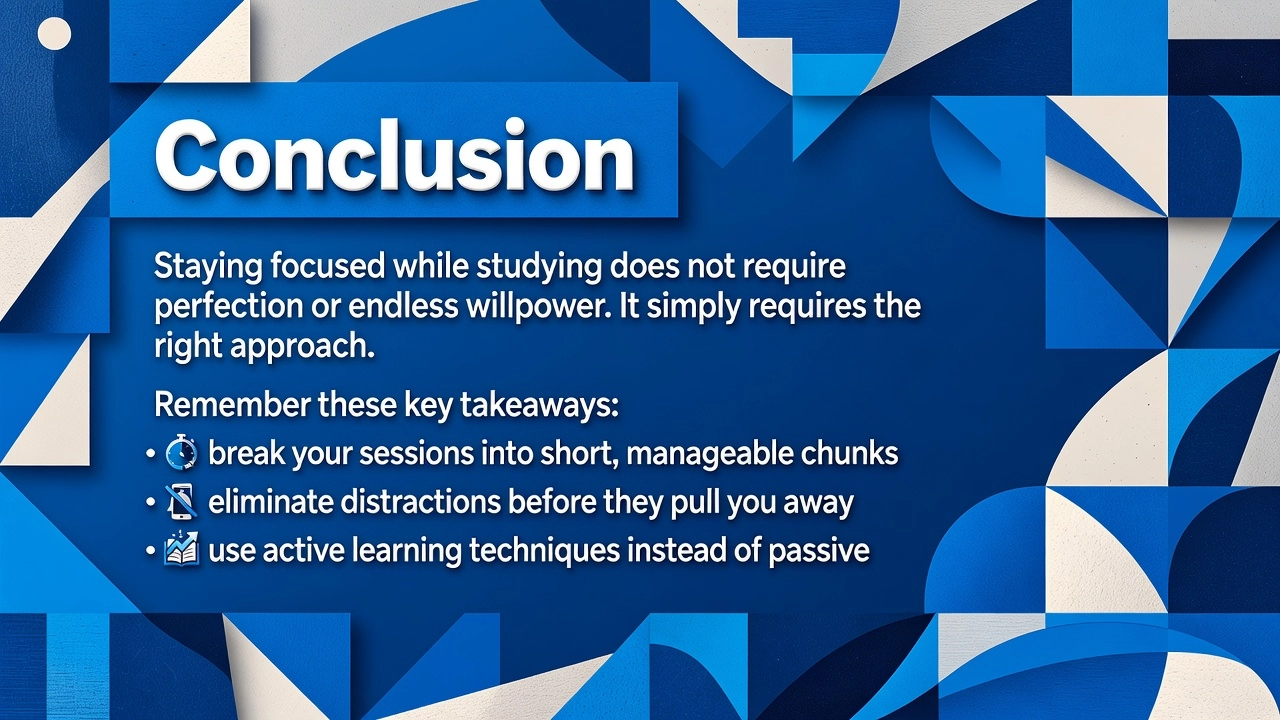
Staying focused while studying does not require perfection or endless willpower. It simply requires the right approach. Remember these key takeaways: break your sessions into short, manageable chunks; eliminate distractions before they pull you away; use active learning techniques instead of passive reading; and give yourself real rewards for staying on track.
The strategies shared in this post are designed for real students with busy minds and short attention spans. You do not need to overhaul your entire routine overnight. Start small, stay consistent, and watch your focus improve over time.
Your next step is simple. Pick one tip from this post and try it during your very next study session. Just one. Progress begins with a single small action. You already have everything you need to study smarter, stay focused, and actually get results. Now go make it happen.

Writer for StudyQuest with 20+ years of teaching experience